
Learn · Practice article
The 5Cs of Knowledge Management™
Collection, Curation, Creation, Collaboration and Contribution: a way to gather, refine, create and share what you know, with citation and attribution running through all five.
By Dr. Michael J. Becker, Identity Praxis, Inc. · . Framework: Identity Praxis, Inc. © 2026.
Why the 5Cs
The 5Cs were born out of necessity. I was tired of wasting time, repeating work and losing knowledge. I developed them to help me discover, refine, organize, use and contribute what I know (implicit, explicit and procedural), so that I can incrementally formalize my insights, my communications and my ability to be of service.
Today we rent intelligence (models), storage (cloud), networks and compute. The one lasting asset we own is our knowledge, and the defining skill of the AI era is managing it. Own your knowledge. Rent the rest.™
Input software and output software
Early in my work I could no longer stomach thinking in output software: word processors, spreadsheets and presentation tools. They are designed for the comfort of consuming content, not for producing it, and not for sense-making: capturing an influx of unstructured input, working with it and pulling insights from it.
Using output software too early formalizes my thinking prematurely, and limits both the depth and the breadth of what I learn and can contribute.
Researchers call this the harm of premature formalization (Shipman & Marshall, 1999). When I work in output software, I work for the software, not for myself or those I serve. I clump too much together too quickly, cut insights that don’t fit the linear, tabular or bulleted mould, repeat the same formatting over and over, scatter duplicate files across my drives, and hunt for the “right” version. I become a tenant farmer for the software. Output software can even contribute to disaster: a single crowded slide has been blamed for hiding the danger that destroyed the Space Shuttle Columbia (Thomas, 2019).
So I do most of my work in input software: text editors, personal knowledge management environments, tools for thought, and open formats I control. I turn to output software only at the end, when I package what I have made, or when I need to collaborate and share with others, humans and AI.
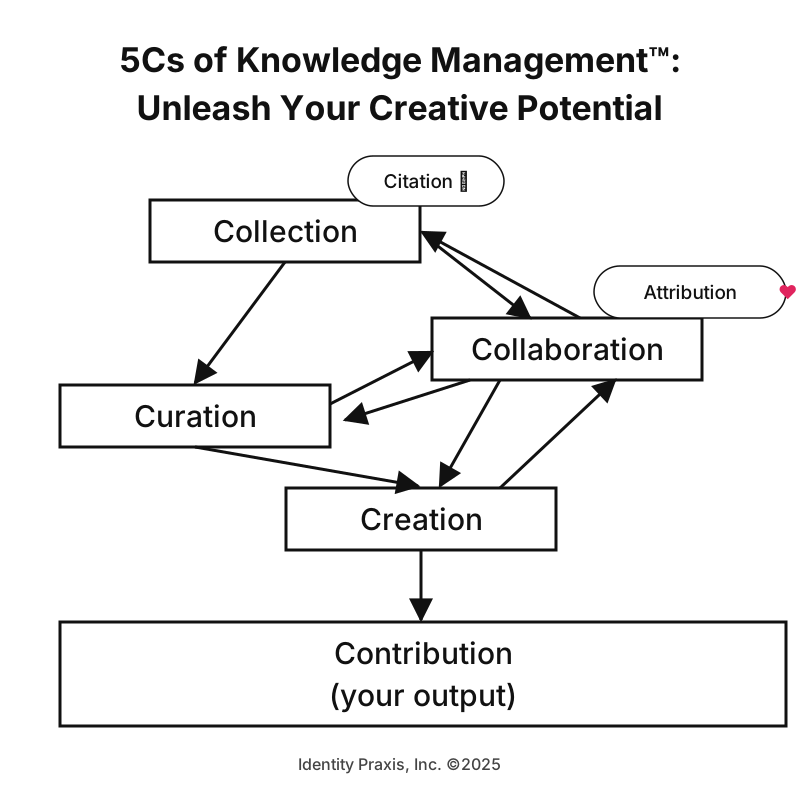
The five Cs
The five form a recursive system, not a straight line. The first four are where you create value. The fifth, Contribution, is the by-product of that work. Knowing this helps you invest your most valuable resource, your time, wisely.
1. Collection
Collection is the systematic gathering of information from many sources, so that valuable knowledge is kept for later. It is conscious noticing, not hoarding: what are you paying attention to, and why?
Citation. Citation is crucial to the whole framework. It documents where each piece of your knowledge came from and how it can be checked, so you keep its provenance and give credit where it is due. We all tell ourselves, “I’ll remember where that came from,” and with so much coming at us, we rarely do. The best place to cite is the moment you collect. Citation keeps your intellectual integrity, builds confidence, helps you resist misinformation and, above all, lets you thank those who came before you.
Try it: collect and cite
- Highlight the sentence above that begins “The best place to cite”.
- Open the citation Praxamark created for this page. Check the title, the author (Michael J. Becker) and the date, and edit anything that’s wrong. It travels with every passage you take from here.
2. Curation
Curation enhances what you collected: tagging, linking, refining, de-duplicating, archiving, filtering and categorizing, until it is your own. You break your collection into atomic pieces, single, concrete, discoverable ideas, each still linked to its source. This makes your knowledge easier to find and use, and it is the first step toward good Creation and Collaboration. What is worth keeping?
Try it: curate
- Highlight the line “What is worth keeping?” and add a note in your own words: why does it matter to you?
- Put the passage in a project, for example “5Cs”, and add a To Do if it reminds you of something to do.
- Look at the labels. Praxamark keeps whose words are whose: the passage is their work, your note is your words about their work.
3. Creation
Creation is where your individuality shines. You generate original knowledge, insights, points of view, frameworks and methods, by assembling your atomic notes (your “zettels”; Ahrens, 2022) into something new: text and media, spoken, printed or digital, for others and for your future self. You’ll know your creations are original because you cited and attributed as you went. Creation also leads to more collection and curation, and it is often the moment to reach out to others. What new insight emerges when you connect the dots?
Try it: create
- Add a thought of your own, with no highlight: one sentence on where you lose knowledge today.
- Praxamark marks it as your own work. If an AI helped you word it, say so, and it is marked as an AI’s words, so you and any AI can always tell them apart.
4. Collaboration
Collaboration, when you are fortunate enough to have it, is where you work with others on your knowledge, and help them with theirs. It leads to more collection, curation and creation. Who shapes your thinking?
Attribution. Attribution is the citation of collaboration. A citable source can be checked; a conversation, a suggestion or an AI’s draft often can’t. So keep track of your collaborators, humans and AI alike, and when you worked together, so you can recognize and thank them. Like citation, attribution is a practice of gratitude.
Try it: collaborate
- Post your passages and notes to where you already think: a folder, Obsidian, Tinderbox or your reference manager. Each one arrives with its citation and its labels.
- With Praxamark Clip or Praxamark Atlas, sign what you share, so others can check it is yours and unchanged.
5. Contribution
In Contribution you share what you know and, I hope, make a difference: in conversations, stand-ups, keynotes and panels, in papers and books, and in digital formats. What you contribute becomes something others collect, and the cycle continues. How will you make a difference?
Content, Structure and Appearance
Alongside the 5Cs I use the CSA framework (Content, Structure, Appearance), because it keeps me from formalizing too soon.
- Content is the text and media, images, video and audio, that are the building blocks of knowledge.
- Structure is how they are organized: sections, headings, tags, lists, tables, visuals, links, indexes and summaries, callouts and footnotes.
- Appearance is how they look: type, colour, tone, white space, alignment, consistency and theme.
Work on content first, add structure as your understanding grows, and leave appearance to the end. That is incremental formalization: you don’t impose a structure on what you know up front; you add it a little at a time, so the system grows with your thinking instead of fighting it.
Focus on where value is created
We put too much value on our outputs: “look at the report I wrote”, “see the talk I gave”. Your output has value and deserves recognition, but it is not the value. It is the by-product of your collections, curations, creations and collaborations. Do the first four Cs well and you build persistent, reusable assets that, over time, speed up everything you make.
Two questions for every note
- Have I credited everyone whose work this rests on?
- Is this note my own understanding, or a copy of the source’s words or an AI’s?
Sources cited here are on References.